Resources
Instant Access - no sign-up required.
This page brings together everything you need to understand, specify and work confidently with the Metalier fully integrated water-based liquid metal system.
In-depth Resources - delivered to your inbox.
Product Overview
Options for Working with Metalier
Designer and Specifiers Guide
Applicators Guide
Distributors Guide
HS Codes
Curious how it all works?
See how to mix, spray and finish Metalier finishes. The first steps to metal artistry.
Mixing for Spraying
Spraying Technique
Finishing the Surface
Related Text
Tips for Finishing and Sealing Surfaces.
How to Create a Verdigris Patina.
Related Text
Introduction to Metalier’s Water-Based System
Partner Resources for Applicators and Distributors.
The appropriate Safety Data Sheet for each Metalier product is supplied with purchase and is available from Metalier HQ on request for specification, freight, and workplace safety requirements.
Applicators should request documentation from their distributor.
Distributors should contact Metalier HQ for access to the appropriate materials.
01
Safety Data Sheets (SDS)
02
Comprehensive Instruction Manual
03
Access to 18 Signature Finishes application videos
04
Customisable Brochures
05
Certified Applicators & Distributor Logos for website.
06
Access to Metalier Images for use in your advertising
Frequently Asked Questions
Metalier finishes are created using real metals and specialised application techniques. Because the process differs from conventional coatings or fabricated metal, designers, architects and applicators often have questions about how the system works. Below are answers to some of the most common questions about Metalier finishes, their application and working with our global network of Certified Metalier Applicators.
01 What makes Metalier different?
Metalier finishes are created using real powdered metals such as brass, bronze, copper and iron.
Once applied and finished, the surface behaves like genuine metal; it can be polished, patinated, aged or sealed just like solid metal.
Metalier is unique in offering a fully integrated water-based system including primers, metal coatings, patinas and protective clear coats.
This creates a cleaner, safer process with extremely low VOC levels compared with many solvent-based alternatives.
The result is the beauty and authenticity of real metal applied seamlessly to almost any form or surface.
02 Is Metalier real metal?
Yes. Metalier coatings contain genuine powdered metals. Once applied and finished, the surface has the appearance and character of metal, because it is metal, and it can develop natural patinas and tonal variation over time.
03 How many finishes are available?
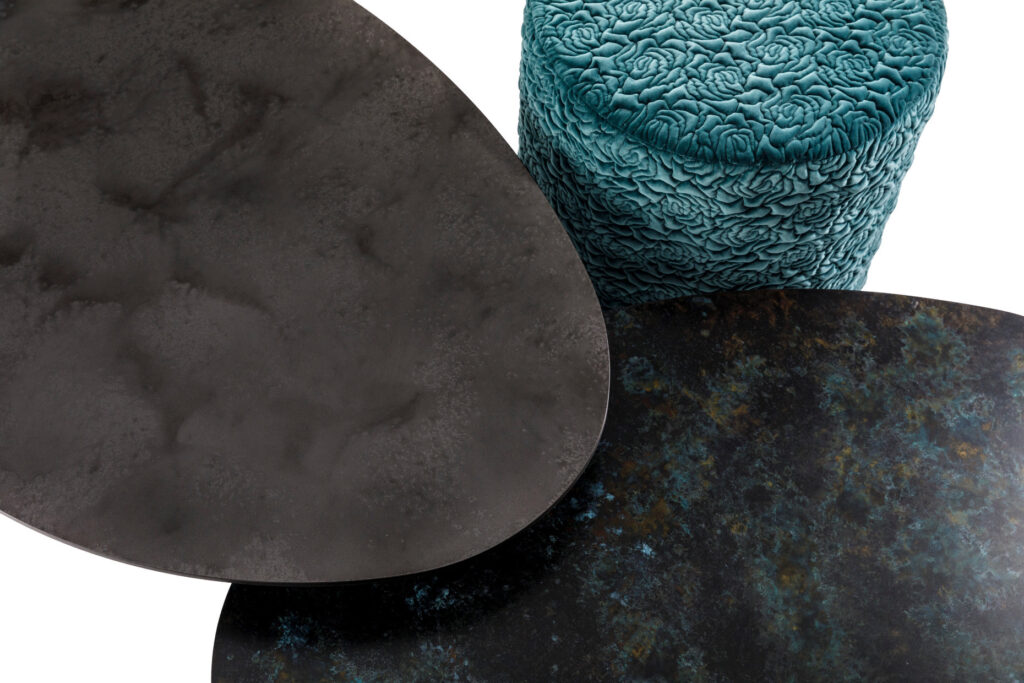
Metalier offers a range of metals, including brass, bronze, copper, iron, nickel silver and gunmetal.
Each metal can be finished in a variety of ways, polished, brushed, antiqued, aged or patinated, creating a wide spectrum of possibilities.
The Metalier Signature Finishes collection showcases a curated selection, and custom finishes can also be developed for individual projects.
04 Is Metalier environmentally friendly?
Metalier has developed a fully integrated water-based system with extremely low VOC levels.
The system avoids the heavy solvents used in many other metal coating processes and allows tools to be cleaned with water.
Because Metalier is applied to lightweight substrates rather than fabricated as solid metal, it can also reduce material use and fabrication energy.
05 What surfaces can Metalier be applied to?
Metalier can be applied to a wide range of substrates, including MDF, timber, plaster, fibreglass, concrete, metal and many composite materials.
This flexibility allows designers to achieve the appearance of solid metal on forms and surfaces that would be difficult, expensive or impossible to fabricate in sheet metal.
06 Are Metalier finishes suitable for outdoor use?
Yes. Metalier finishes can be used outdoors when they are properly sealed and protected with the appropriate clear coating system.
As with all real metals, exposure to weather and environment may influence how the surface ages over time.
Some designers welcome this natural evolution, while others choose protective coatings that stabilise the appearance.
07 How durable are Metalier finishes?
When correctly applied and sealed, Metalier finishes are highly durable and suitable for many architectural interior applications, including wall panels, feature elements, furniture and joinery. Durability depends on the metal selected, the patina applied and the final protective clear coat.
08 Can Metalier surfaces be cleaned?
Yes. Once sealed, Metalier finishes can generally be cleaned using mild soap and water or gentle non-abrasive cleaners.
Harsh chemicals and abrasive pads should be avoided as they may damage the protective coating.
09 Will every finish look exactly the same?
No: and this is one of the defining qualities of real metal.
Metalier finishes are created using natural metal reactions and patinas. This means each surface develops subtle variation and depth.
Metalier finishes combine visual consistency with the natural variation of real metal, a quality we describe as controlled unpredictability.
10 Can I apply Metalier finishes myself?
In some cases, yes. A skilled and practical person may be able to apply simpler finishes successfully.
However, most architectural projects are completed by Certified Metalier Applicators who have been trained in the Metalier process.
This ensures consistent quality and allows more complex patinas and finishes to be achieved.
11 How do I become a Certified Metalier Applicator?
Metalier works with a global network of Certified Metalier Applicators.
Certification involves training in the Metalier application process, either in person or via video links, and finishing techniques, as well as ongoing support from Metalier International.
If you are an experienced finisher, decorative applicator, joiner or specialist surface applicator and would like to explore certification, please contact us for further information.
12 How can I become a Metalier distributor?
Metalier works with a carefully selected group of distribution partners internationally.
Distributors supply Metalier products within their region while supporting the growth of a local network of Certified Applicators.
If you are interested in distribution opportunities, please contact Metalier International with information about your company, territory and experience in architectural surface products.
13 How thick is a Metalier finish?
Metalier finishes are typically around 1 – 2 mm thick or less, depending on the application method and finishing process.
This allows the appearance of solid metal to be achieved without the weight or fabrication constraints of sheet metal.
14 Can Metalier be applied to curved or complex shapes?
Yes. One of Metalier’s greatest advantages is its ability to be applied seamlessly to curved, sculptural and complex forms that would be extremely difficult to fabricate from solid metal.
15 Can Metalier finishes be repaired or refinished?
In some cases, yes, but it depends on the type of finish.
Highly polished or very smooth finishes can be difficult to repair invisibly because even small variations may be visible across a uniform surface.
However, patinated, aged or textured finishes are often repairable because their natural variation allows careful blending of the repaired area into the surrounding surface.
A Certified Metalier Applicator can advise on the best approach for a particular project.
16 Can Metalier achieve a consistent finish across multiple panels?
Yes. Certified Metalier Applicators are trained to produce finishes that are visually consistent across multiple panels and large installations.
Because Metalier uses real metals and reactive patinas, subtle variation is part of the character of the material.
Metalier finishes combine visual consistency with the natural variation of real metal, a quality we describe as controlled unpredictability.
17 Can Metalier replicate aged or antique metal finishes?
Yes. One of the strengths of the Metalier system is the ability to create a wide range of aged, antiqued and patinated metal finishes.
By combining real metal coatings with specialised patinas and finishing techniques, applicators can create finishes that range from softly aged surfaces to dramatic oxidised effects.
18 When should Metalier be specified in a project?
Metalier can often be introduced at different stages of a project, but the best results are achieved when it is considered early in the design process.
Early specification allows designers to select the most suitable substrate, detailing and finishing approach, and ensures the project team can work with a Certified Metalier Applicator from the beginning.
19 Why not simply use sheet metal?
Sheet metal is an excellent material, but it comes with weight, cost and fabrication limitations.
Metalier allows designers to achieve the beauty and character of real metal while applying it to forms, surfaces and scales that would be extremely difficult or expensive to fabricate from solid sheet metal.
Because the finish is applied directly to the substrate, it opens up new possibilities for seamless surfaces, sculptural forms and complex architectural elements while maintaining the authenticity of real metal.
Excited? Get in Touch
Real liquid metal finishes: without the weight, cost, and fabrication limits of solid metal.