
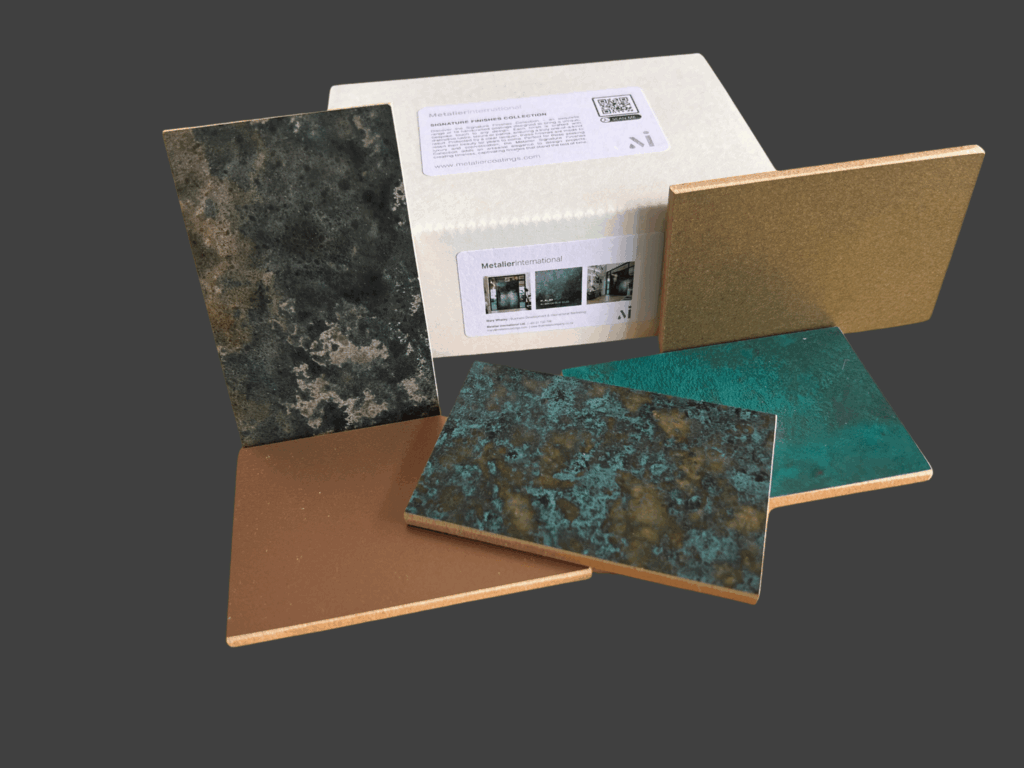
“Liquid metal paint” is one of the most common ways people find Metalier online.
And I understand why.
If you are looking for a product that can give a wall, door, piece of furniture or architectural surface the appearance of real metal, liquid metal paint is a perfectly logical thing to type into a search box.
I use the expression myself.
Occasionally.
In fact, with our new team in the United States, it has become something of a joke. Everyone is allowed to call Metalier “paint” once during a meeting.
After that, privileges may be withdrawn.
That is partly because I am a bit of a liquid-metal snob.
But mostly it is because, although Metalier can be applied rather like paint, what happens afterwards is very different.
So is liquid metal paint actually paint?
Yes – until it isn’t.
Metalier starts as a liquid coating system containing genuine metal. It can be sprayed to create a smooth surface or applied by hand when texture is wanted. Once cured, the surface can be sanded and polished to reveal the metal beneath. It can then be left natural, textured, aged or treated with patinas to create completely different effects. Metalier Liquid Metal Design & …
That is where the comparison with ordinary paint begins to break down.
With conventional paint, the finish that comes out of the gun, roller or brush is essentially the finish you are trying to achieve.
The skill lies in applying it beautifully.
With Metalier, application is only the beginning.
The applicator becomes part technician, part craftsperson and part artist.
Which is why we call ourselves Metalier: metal + atelier, the French word associated with an artist’s or artisan’s workshop.
What comes out of the tin is not the finished result
This distinction matters.
A Metalier applicator can take the same core material and create something smooth and refined, heavily textured, aged, polished, distressed or patinated.
The finish is developed after application.
That is why we describe Metalier as a specialist artisan coating rather than simply a metallic paint.
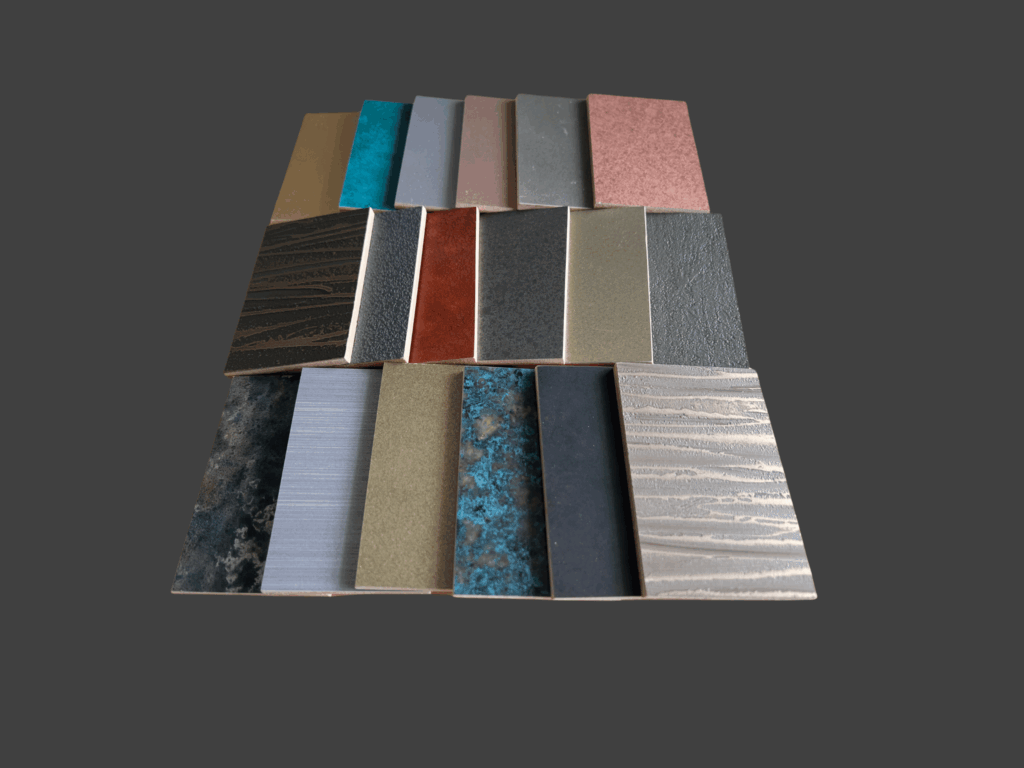
Look at the finishes above.
They have not come from 18 tins containing 18 different decorative paints.
They are the result of real metal combined with different application and finishing techniques.
Some are polished.
Some are textured.
Some have been patinated.
Some are deliberately aged.
And some are allowed to show the metal in a much quieter form.
That human intervention is a large part of what makes the finished surface interesting.
Then FedEx gets involved
All of which is very well until you try to send a box of samples through international Customs.
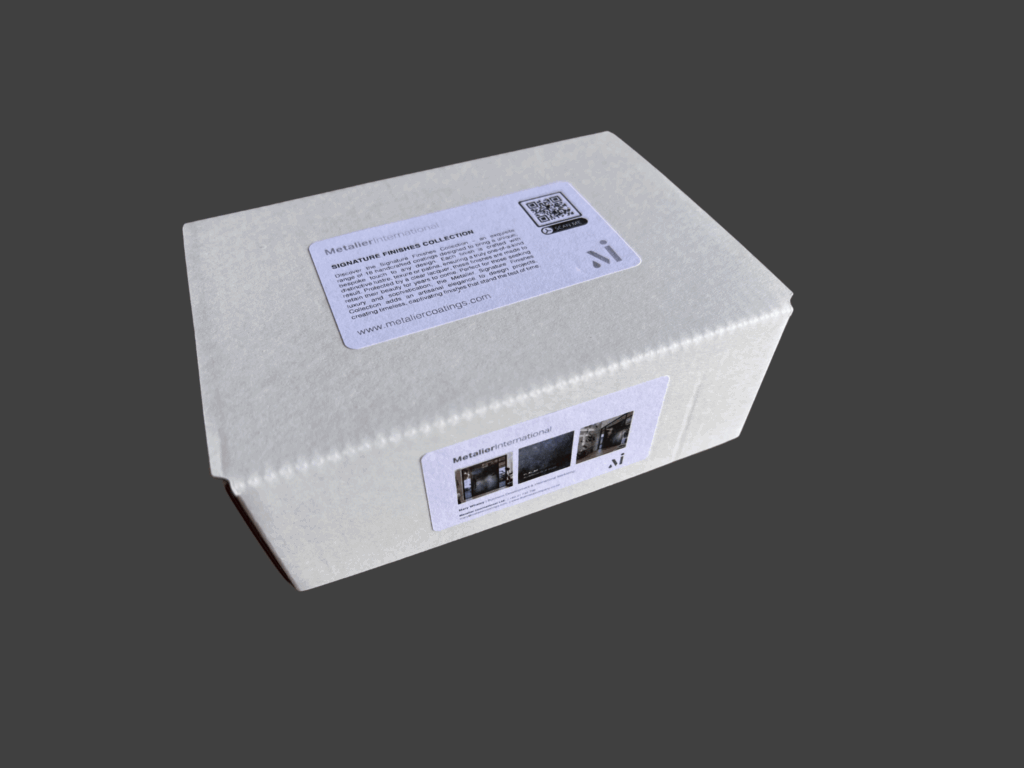
Recently we sent one of our sample boxes from New Zealand to the United States.
FedEx needed additional information.
Perfectly reasonably, they asked whether the samples were a paint/coating or a laminate.
A dry coating sample, I replied.
Then came the next question:
If it is a paint/coating sample, how many litres are in each sample?
There is something rather wonderful about being asked to measure a dry, finished decorative sample in litres.
But Customs classifications require answers, so we did the calculation.
The answer was:
up to 0.002 litres per sample.
At that point all my objections to the word “paint” disappeared remarkably quickly.
When dealing with freight forwarders and Customs, simple descriptions can be very useful.
“Metallic paint/coating sample” gets everybody moving in roughly the right direction.
Sometimes terminology is about technical precision.
Sometimes it is about getting the box through Customs.
Why people search for liquid metal paint
More importantly, people searching for liquid metal paint usually know exactly what they want.
They want the beauty of metal without necessarily fabricating an entire object from sheet or solid metal.
They may want to coat something curved, detailed or already constructed.
They may want a seamless metal surface.
Or they may simply have seen a beautiful metallic finish and want to know how it was created.
“Liquid metal paint” gets them to the right neighbourhood.
Then we can explain what is possible once they arrive.
The difference is in what happens next
Perhaps that is the simplest distinction of all.
A liquid metal coating can be applied.
An artisan metal finish is created.
The material matters, of course. But so do the applicator, the tools, the sanding, polishing, texture, patina and decisions made along the way.
The result is not intended to imitate metal.
It is a surface containing genuine metal, capable of being finished in ways that take advantage of those metallic qualities. Metalier Liquid Metal Design & …
So if you arrived here after searching for “liquid metal paint”, welcome.
You weren’t wrong.
Just don’t say “paint” more than once at one of our meetings.