
Last week we looked at what metal coating finishes are.
This week, rather than explain them again, I thought it would be more useful to show what they can do.
The Sugar Club was one of those projects.
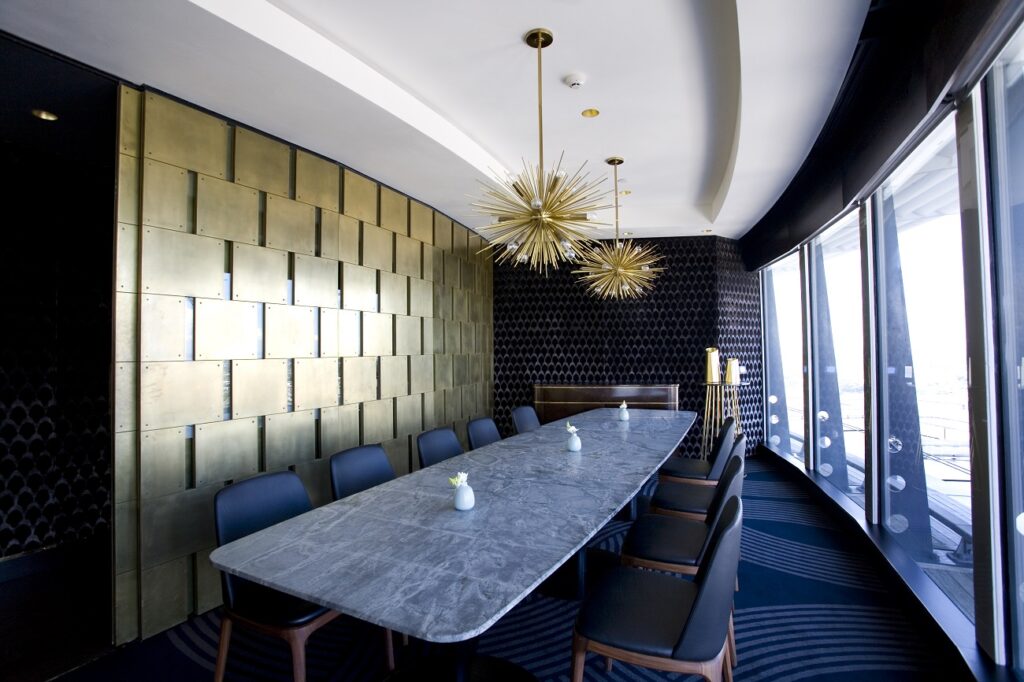
Opened in 2013 on Level 53 of Auckland’s SkyTower, the restaurant used brass extensively throughout the interior – but not always in the same way.
Sometimes solid brass was the right answer.
Sometimes sheet brass was the right answer.
And sometimes a real metal coating could do something that conventional metal fabrication could not do nearly as easily.
One metal, several different jobs
Brass was part of the visual language of The Sugar Club from the moment you entered.
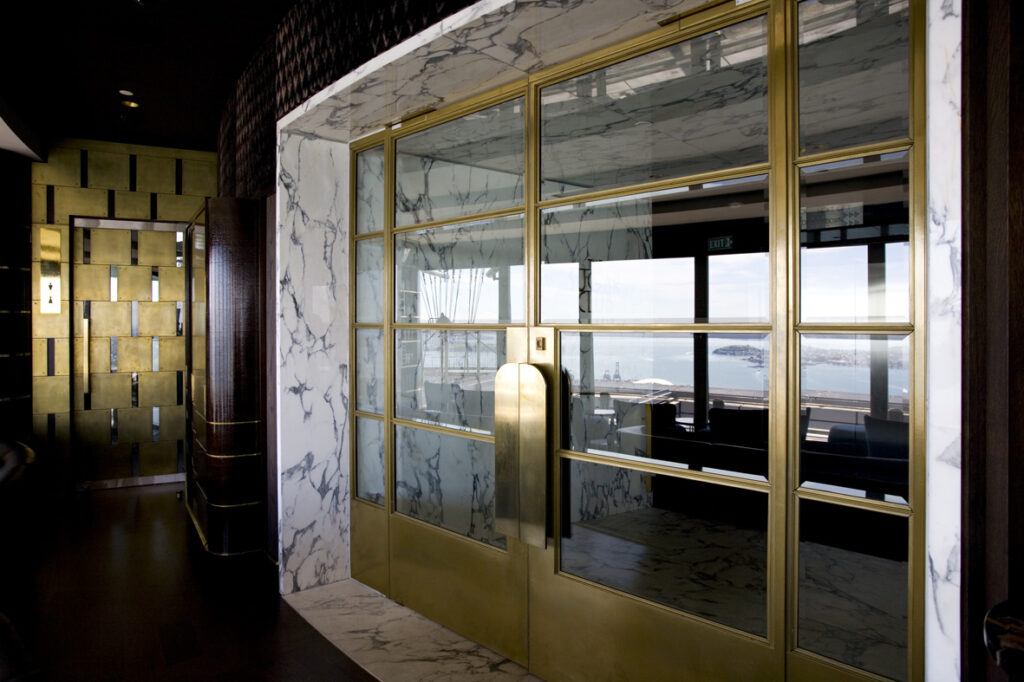
The entrance doors themselves were steel, finished in Metalier polished brass. The large handles were solid brass.
Placed together, they blended remarkably well.
That is an important point about real metal coatings.
They do not always need to replace traditional metal.
Very often, the best result comes from using each material where it makes most sense.
Solid metal where solid metal works.
Sheet metal where sheet works.
And a metal coating where the shape, substrate or application calls for something more adaptable.
From the Metalier archives: polished brass and other Metalier finishes at The Sugar Club. Auckland.
Brass over an existing form
The project included panelled doors finished in polished Metalier brass over MDF, together with brass finishes on shelving and other detailed elements.
The underlying form already existed.
Rather than fabricating an entirely new object from solid or sheet brass, the metal finish became part of the surface itself.
That is one of the useful distinctions between a coating and conventional fabrication.
A metal coating can follow the object.
It does not require the object to be redesigned around the limitations of sheet metal.
Brass at architectural scale
The private dining room took the idea much further.
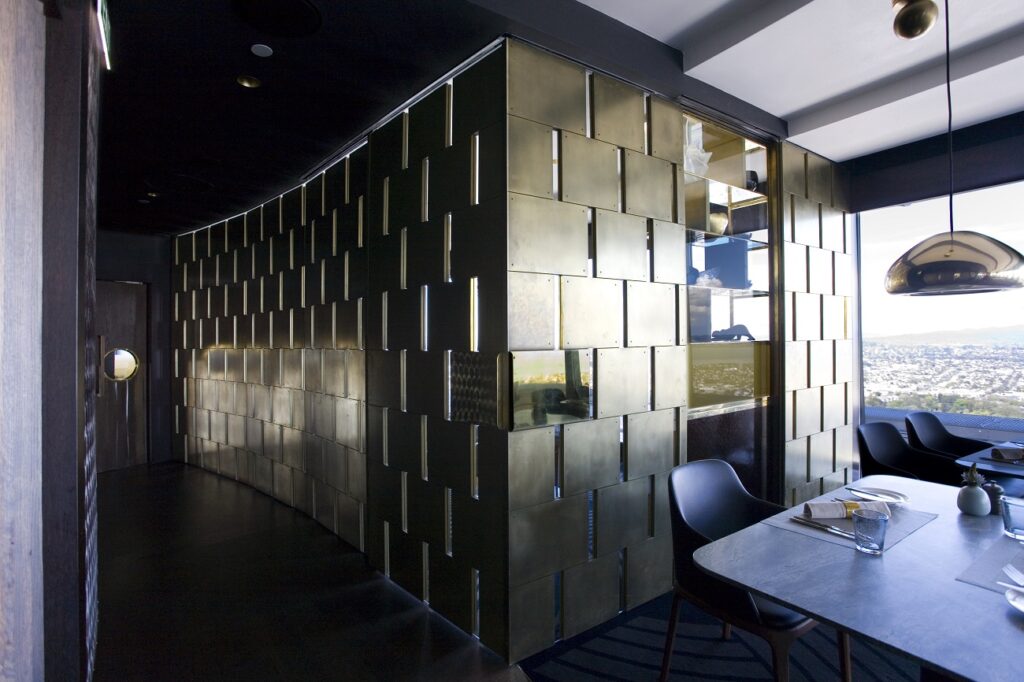
Large areas were encased in brass-finished panels, creating a surface that changed constantly with the light.
At that scale, brass stops behaving like a decorative accent.
It becomes part of the architecture.
And because the surface is real metal, subtle differences in polishing, light and viewing angle give it the variation that makes metal interesting in the first place.
The drinks servery, wine shelving and glass shelving all continued the brass language in smaller details.
The same material family appeared again and again, but never in quite the same way.
Then there were the portholes
This is still one of my favourite details in the whole project.
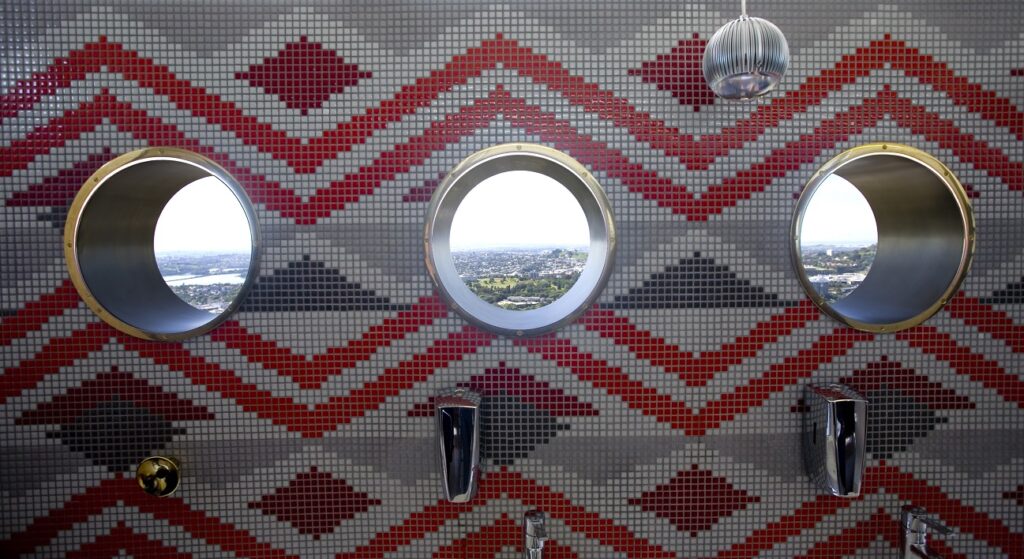
The face flashing around the portholes was sheet brass.
The curved interior reveals were finished in Metalier brass.
That combination illustrates the point beautifully.
Sheet brass was completely appropriate for the flat face.
But taking sheet metal smoothly around those deep internal curves would have been a very different fabrication exercise.
The coating could simply follow the form.
So the two methods sat side by side – not competing, but solving different parts of the same design problem.
This is one reason I am wary of conversations that ask whether a metal coating is “better” than sheet or solid metal.
That is usually the wrong question.
The better question is:
Which method is right for this particular surface?
The practical reality: Level 53
There was another complication.
The Sugar Club was on the 53rd floor of the SkyTower.
Everything needed for the work – materials, tools and equipment – had to travel up through the tower using one of four high-speed elevators while the building remained open to the public.
That makes material choice rather less theoretical.
Weight, size, access, movement through an occupied building and the practicalities of getting everything to the workface all become part of the specification.
Beautiful finishes still have to get to site.
And sometimes the cleverest material is the one that makes the design possible without creating another problem somewhere else.
Not every surface was brass
Although brass was the dominant metal story, Metalier aluminium was also used on the kitchen bar.
That matters because the project was not about covering everything in one finish.
It was about choosing different metals and techniques according to the design.
That is how specialist coatings are most useful.
Not as a substitute for every other material.
As another tool in the designer’s kit.
What The Sugar Club shows us
The Sugar Club closed in 2024, more than a decade after it opened.
But the project remains a very good example of what metal coating finishes can do.
They can sit beside solid metal.
They can sit beside sheet metal.
They can cover large architectural surfaces.
They can follow curves.
They can work on doors, shelving, panels and detailed joinery.
And perhaps most importantly, they allow the designer to think about the surface they want, rather than beginning with the manufacturing limitations of a particular form of metal.
Last week we asked: what is a metal coating finish?
The Sugar Club gives us one answer:
It is another way of designing with real metal.
If you are considering a brass or other real-metal finish for an architectural or interior project, talk to us about the surface, substrate and result you want to achieve.