
Spectacular projects are rarely the work of one company.
They usually happen because a number of people, often in different countries and with very different responsibilities, understand what they are there to do , and do it well.
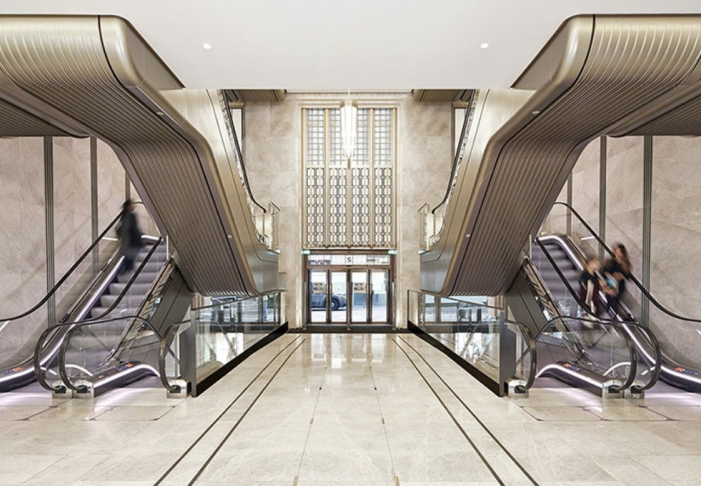
One of the best examples in Metalier’s history is the Harrods escalator project in London.
It was an ambitious project from the beginning, and it only worked because every party understood its role.
The opportunity was identified in the UK, with significant input from our distributor at the time. The project then involved contractors from Hong Kong, training in the UK, product supply from New Zealand, application work in China, and final installation back in London.
That is a long chain.
And long chains only work when the links are strong.
From London to Hong Kong, New Zealand, China – and back again
The Harrods project began in London.
Our UK distributor, led by Craig and Alison McDonald, helped identify and develop the opportunity and acted as the bridge between the client, the contractors and Metalier.
Contractors from Hong Kong were trained in the UK by Craig and Ali so that they understood the Metalier system and how it needed to be applied.
The Metalier material itself was supplied from New Zealand and shipped to Hong Kong, then onward to China, where the application work was completed under the direction of the Hong Kong contractors.
The completed escalator structures were then shipped back to the UK for installation at Harrods.
The installation itself was no small matter. Part of the roof of the store had to be removed to allow the escalators to be brought into the building.
By the time the finished project was in place, it had involved designers, distributors, contractors, trainers, manufacturers, logistics teams and installers across several countries.
No single party could have delivered it alone.
Why the distributor relationship mattered
It would be easy to describe distribution as stock, pricing and product supply.
But that is only one part of it.
A good distributor does much more.
The distributor understands the local market. They identify opportunities. They help connect specifiers, contractors and the manufacturer. They support communication. They make sure questions are answered and that issues are dealt with before they become problems.
In the Harrods project, the distributor relationship gave the project leadership and continuity.
Craig and Ali understood both the commercial opportunity and the technical requirements. They helped coordinate the many moving parts and kept the project moving in the right direction.
That kind of distributor partnership is incredibly valuable.
Everyone needs to know their role
One of the clearest lessons from a project like Harrods is that international collaboration depends on clarity.
Who is responsible for the specification?
Who is responsible for training?
Who supplies the material?
Who applies it?
Who checks quality?
Who communicates with the client?
Who resolves problems when something unexpected happens?
If those responsibilities are vague, projects become difficult very quickly.
If they are understood, even complex projects can move smoothly across borders.
Communication is what holds the whole structure together.
Not endless meetings. Not bureaucracy.
Simply making sure the right people know what is happening, what is expected of them and what comes next.
Distribution means creating demand as well as fulfilling it
This is something we believe strongly at Metalier.
Distribution is not simply waiting for an order and shipping product.
It means helping create the market.
That can include introducing the material to designers and architects, supporting applicators, providing samples, developing project opportunities and helping clients understand what Metalier can make possible.
Metalier supports that process with training, technical backup, marketing assets and project support. Our distributor framework is built around active market development, not passive supply.
The strongest distributor relationships work because both sides are investing in the same outcome.
And it helps if you enjoy working together
This part is sometimes overlooked.
Business relationships work better when people like dealing with one another.
That does not mean avoiding difficult conversations or pretending everything is always perfect.
Quite the opposite.
Strong relationships make it easier to raise problems early, ask questions, challenge assumptions and find solutions.
There should be professionalism, clarity and accountability.
But there should also be some enjoyment.
The best partnerships tend to have both.
What we look for in a distributor
Metalier continues to build its international network, and we are interested in talking to experienced businesses that see distribution as a long-term partnership.
We look for partners with access to designers, architects and builders, the ability to support stockholding, marketing and training, and a genuine commitment to representing Metalier well in their market. Metalier Distributor Brochure_0…
Most importantly, we look for people who understand that distribution means creating demand as well as fulfilling it.
Great projects need great products.
But they also need great partnerships.
And the Harrods escalator project is one of the best examples we have of what can happen when every party understands its role and works towards the same result.