
People often ask whether decorative liquid metal finishes are really metal.
It is a fair question.
We live in a world full of clever surface finishes. Timber can be printed onto laminate. Marble can be recreated in porcelain. Metal can appear in paint, foil, sheet, printed panels, laminates and coatings.
Many of these surfaces are useful, beautiful and entirely appropriate in the right setting.
But they are not all the same thing.
So when someone looks at a Metalier finish and asks, “Is it real metal?”, the answer is simple.
Yes.
Just not in the form they may have expected.
Why people ask whether it is real metal
When people first see a decorative metal surface, they naturally try to place it into a category.
Is it paint?
Is it sheet metal?
Is it a printed metal surface?
Is it a laminate?
Is it a decorative effect?
That reaction makes sense. The surface industry has become very good at creating convincing finishes, and many of them do exactly what they are designed to do.
Printed metal surfaces, for example, can be excellent where consistency, repeatability and thin sheet material are important. Sheet metal is ideal when fabrication, folding and traditional metalworking are required. Metallic paint can be useful when a project needs colour, shimmer or a lower-cost decorative effect.
Each has its place.
Metalier sits in a different category.
It is not trying to imitate metal through colour or pattern. It creates a real metal surface using real metal powders blended into a liquid coating system.
The usual suspects: paint, print and sheet metal
Metallic paint creates the visual impression of metal. It may sparkle, shimmer or reflect light, but the surface itself is still paint.
Printed metal and decorative laminates can reproduce pattern, colour and visual texture. They can be extremely effective, especially where a project needs consistency across panels or where the design intent suits a printed surface.
Sheet metal is metal in its most familiar architectural form. It can be folded, cut, fabricated and installed as panels, trims, doors, counters and many other elements.
The question is not which one is best.
The question is which one is right for the job.
A printed metal surface may be perfect for one project. Sheet metal may be the right answer for another. Paint may be entirely suitable where a decorative metallic effect is enough.
But where the brief calls for a genuine metal surface on a substrate, shape or form that would be difficult, costly or impractical to fabricate from sheet metal, decorative liquid metal finishes offer another solution.
What makes decorative liquid metal finishes different?
Metalier is made with real atomised metal powders.
Bronze, brass, copper, iron, nickel silver, aluminium, gunmetal and other metals can be blended into the Metalier system and applied to prepared surfaces.
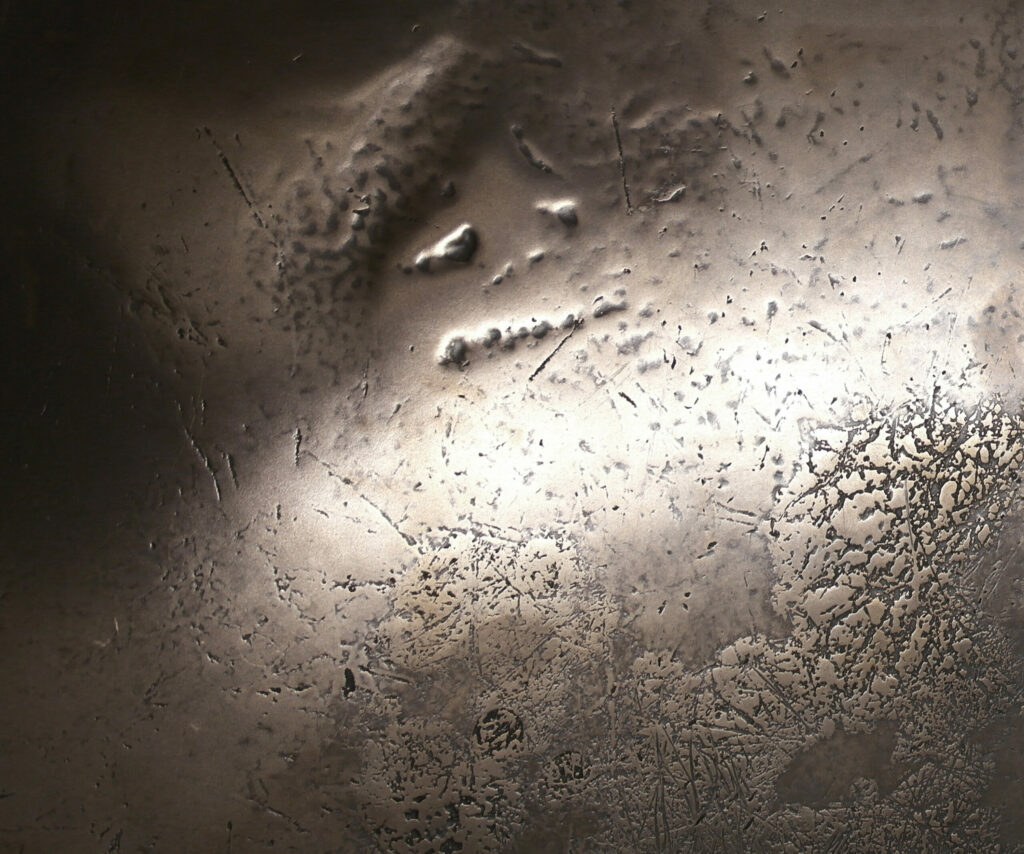
Once cured, the coating forms a real metal surface. It can be sanded, polished, buffed, textured, aged with patina, or protected with clear coat.
That is why the finish has depth.
Light moves across it differently.
A polished area can catch the eye while a textured recess remains softer and darker.
It is why people often want to touch it.
The surface behaves like metal because it contains metal.
Why real metal powders matter
Real metal has character.
It is not always perfectly flat or visually silent. It can show movement, texture, warmth, patina, reflection and variation. Those qualities are part of its appeal.
With Metalier, the metal powders are not simply there to colour the coating. They are the substance of the finish.
That matters because it allows designers and applicators to work with the surface after application. The finish can be refined, revealed and changed through sanding, polishing and patination.
A smooth bronze finish can feel calm and architectural.
A dark aged brass can feel moody and luxurious.
A rusted iron surface can feel raw and industrial.
A copper verdigris finish can bring colour, age and drama.
These are not printed effects sitting on top of a surface. They are metal finishes created through material, technique and hand finishing.
A real metal finish without sheet metal limitations
One of the reasons decorative liquid metal finishes are so versatile is that they are applied as a coating.
That opens possibilities that would be difficult with traditional sheet metal.
Metalier can be used on curves, columns, doors, wall panels, cabinetry, reception desks, bar fronts, furniture, sculptural forms and many other surfaces. It can be applied in a workshop, and in some cases on site.
It can cover substrates that would not usually be made from solid metal.
It can create seamless effects across complex forms.
It can also reduce weight and fabrication constraints while still delivering the appearance, feel and authenticity of real metal.
That does not make sheet metal unnecessary.
It simply gives designers another way to use metal.
The honest answer
So, will the real metal please stand up?
In the case of Metalier, yes.
It is real metal.
It is not metallic paint. It is not a printed image of metal. It is not sheet metal.
It is a decorative liquid metal finish made with real metal powders and applied in a form that gives designers, architects and makers far more freedom.
That is the part we still find exciting.
Metal does not have to stay flat, heavy or difficult.
Sometimes it can be sprayed, trowelled, brushed, textured, polished and patinated.
And sometimes, when people first see it, they simply ask the best question of all.
“Is it really metal?”